

Socioeconomic Disparities in Rural Ecuador: A Census-Based Data Analytics Approach to Territorial Development in Yaguachi Canton
Article Sidebar
Main Article Content
Abstract
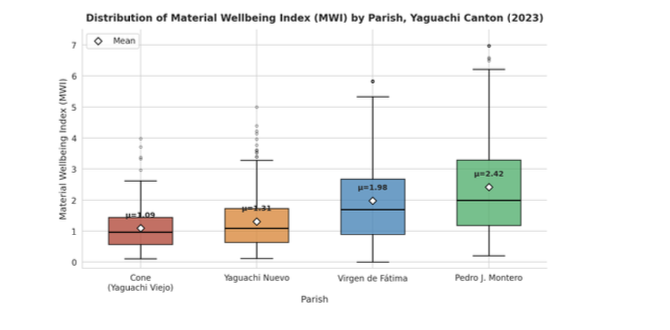
Rural territories in developing countries face persistent socioeconomic inequalities that are rarely examined through systematic census data analytics at the parish level. Ecuador's coastal rural cantons represent particularly data-sparse environments for evidence-based policymaking. This study applied census data analytics techniques to characterize and compare the socioeconomic conditions of three rural parishes Cone, Virgen de Fátima, and Pedro J. Montero within Yaguachi Canton, Guayas Province, Ecuador, using 2023 census microdata, quantitative, non-experimental, cross-sectional study was conducted. The dataset included 6,872 census records covering all three parishes (n=941 Cone, n=1,355 Virgen de Fátima, n=1,447 Pedro J. Montero). Variables analyzed included demographic structure, educational attainment, labor market participation, income levels, housing quality, access to basic services, internet connectivity, and a composite Material Wellbeing Index (MWI/IBM). Descriptive statistics, box-plot comparisons, non-parametric tests, and data visualization were performed using Python and R. All three parishes exhibited demographic aging (median age >50 years), female predominance (52–67%), very low formal employment (<1.1%), and high labor informality (6.9–16.1%). Digital exclusion was severe (1.6–25.8% internet access). The MWI revealed significant inter-parish disparities: Pedro J. Montero (mean=2.42) > Virgen de Fátima (mean=1.98) > Cone (mean=1.09). Education level was the strongest predictor of MWI across all parishes. Census data analytics reveals structured socioeconomic inequalities across rural Yaguachi parishes, with Cone exhibiting the most vulnerable profile. Evidence-based territorial planning requires systematic use of disaggregated census microdata and composite wellbeing indices.
Downloads
Article Details

This work is licensed under a Creative Commons Attribution-NonCommercial-ShareAlike 4.0 International License.