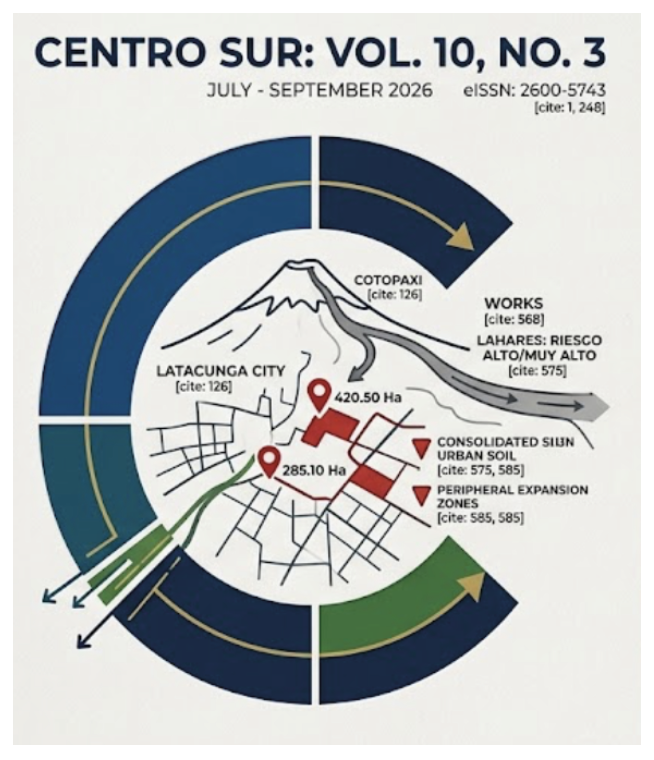
Volume 10, Issue 3 of the Revista Centro Sur compiles three critical studies that examine the profound disconnect between theoretical regulatory frameworks and their practical application in the face of the challenges of contemporary society, such as environmental risk management, criminal due process, and ethics in artificial intelligence. Through a spatial analysis using Geographic Information Systems in the canton of Latacunga, the first study demonstrates that the proliferation of informal land markets and weak municipal oversight exacerbate socioeconomic vulnerability to the volcanic risk posed by Cotopaxi, showing that the effectiveness of national land-use planning laws is strictly limited by the technical and financial capacities of local governments. For its part, the second study addresses the doctrinal evolution of unlawfulness from a classical formalist approach toward a substantive understanding aimed at limiting the State’s punitive power, highlighting the incorporation of the pro-persona principle into grounds for justification and warning of the procedural distortions generated by punitive populism in current criminal rationality. Finally, the third study examines the ethical-legal tension caused by the rise of artificial intelligence in relation to the right to informational self-determination, identifying critical issues such as algorithmic bias and the opacity of so-called “black boxes,” while concluding that Ecuador’s regulatory framework exhibits institutional shortcomings and legal fragmentation that limit the integration and commercialization of local technological developments in international markets compared to standards such as the European Union’s General Data Protection Regulation. Taken together, these three articles agree that mere formal compliance with laws on paper is insufficient, highlighting the urgency of moving toward models of active governance, effective substantive oversight, and the absolute primacy of individuals’ fundamental rights in the face of the technical, territorial, and punitive realities of our time.
DOI: https://doi.org/10.37955/cs.v3i2
Published: 2026-07-02
Artículos